
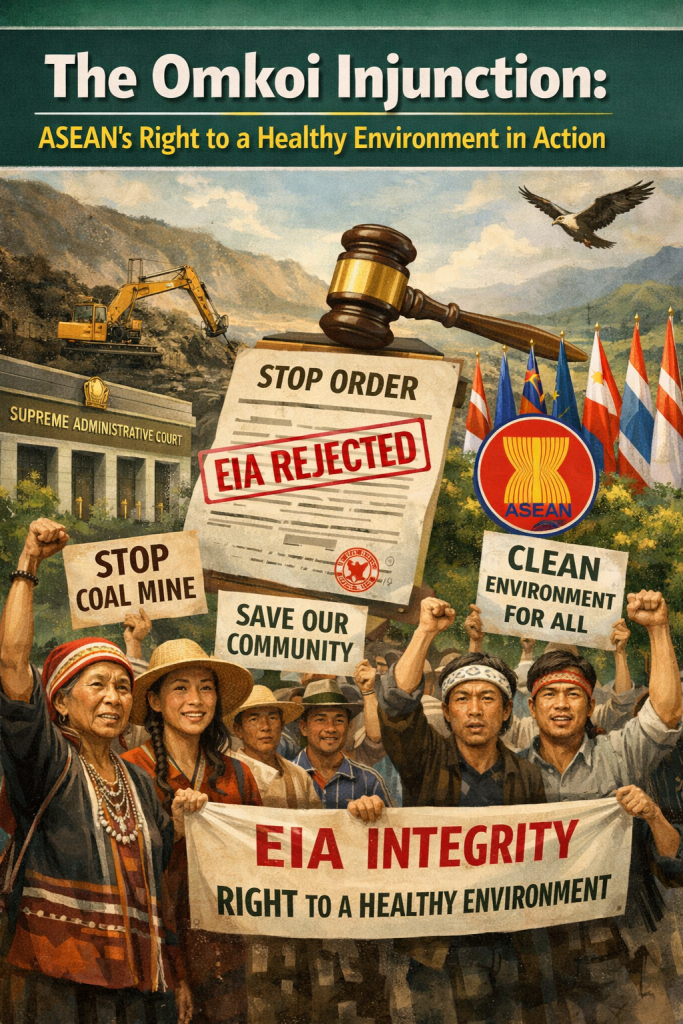
ASEAN made headlines in late 2025 by adopting the ASEAN Declaration on the Right to a Safe, Clean, Healthy and Sustainable Environment. It was a rare moment of regional clarity: a collective promise that people across Southeast Asia are entitled not just to development, but to development that does not poison air, water, health, and livelihoods.
But declarations have a problem in this region. They can become diplomatic wallpaper—beautiful language with no teeth, no pathway, no consequence. The real test is implementation: when an environmentally risky project arrives with a glossy report and political momentum, does the “right” actually change what happens next?
This is why Thailand’s Omkoi coal mine case matters far beyond Chiang Mai.
On 13 February 2026, Thailand’s Supreme Administrative Court reaffirmed a temporary injunction that prevents the Omkoi coal mining project from moving forward while the core lawsuit is still pending. The court’s message—practical, not poetic—was that the project cannot keep advancing through the permitting chain using a contested EIA. (EarthRights International)
It is exactly the kind of governance move ASEAN needs if it wants its new right to be more than a slogan.
A court didn’t “stop development”—it demanded lawful, truthful development
The Omkoi case is not a final judgment on the mine. It is something more basic, and more powerful: an insistence that the rules of environmental decision-making must be real.
The lawsuit—filed in 2022—alleges that the EIA process failed on the fundamentals: meaningful consultation, inclusion of community voices, and full accounting of environmental and social risks. (EarthRights International) The injunction is grounded in a principle too often missing from fast-tracked projects: once the harm is done, it can be irreversible—to watersheds, farms, forests, health, and local economies. Courts exist precisely to prevent that kind of “approve-now, regret-later” governance.
This is where Omkoi illuminates a path for ASEAN. It shows how a right becomes operational:
- Process integrity is treated as substantive—not a box-ticking exercise.
- Evidence quality (EIA credibility) becomes a gatekeeper for permits, not window dressing.
- Remedy arrives in time—before harm becomes permanent.
If ASEAN is serious, this is the implementation posture it needs to normalize across member states.
ASEAN already wrote the blueprint. Omkoi shows how to enforce it.
Read the Declaration closely and it’s clear: ASEAN did not only promise “clean air” and “clean water.” It promised the procedural machinery that makes those outcomes possible.
In plain terms, ASEAN committed to advancing: access to information, meaningful public participation, and access to justice. It “strongly encourage[d]” the use of risk assessment tools, including EIAs, to prevent and mitigate harm. It also pledged a safe and enabling environment for people to exercise this right—language that matters in a region where environmental defenders are too often intimidated into silence.
Omkoi is those clauses, translated into practice.
- “Access to justice” is not a seminar topic. It is an injunction that pauses an approval process when credible legal concerns are raised. (EarthRights International)
- “Meaningful participation” is not a public hearing photo-op. It is participation that, when defective, can trigger judicial intervention. (EarthRights International)
- “EIA as a risk tool” is not a consultant’s report. It is a decision document that must withstand scrutiny—or it cannot be used to unlock permits. (EarthRights International)
And crucially: the Declaration doesn’t leave implementation to vibes. It explicitly tasks AICHR, in consultation with ASEAN environmental bodies including ASOEN, to develop an ASEAN-owned Regional Plan of Action. AICHR has already begun moving in that direction through a regional consultation in December 2025 focused on operational issues like information access, participation, justice, vulnerable groups, and responsible business conduct. (AICHR)
So the question is no longer “what should ASEAN do?” The question is whether ASEAN will adopt the kind of standards that make cases like Omkoi normal, not exceptional.
How to make the ASEAN Declaration “work”: adopt the Omkoi standard, region-wide
If AICHR and ASOEN want a Regional Plan of Action that actually shifts outcomes, it should be built around enforceable implementation mechanics—things agencies, companies, financiers, and courts can’t ignore.
Here are six concrete moves—an “Omkoi standard” for ASEAN:
1) Make EIA integrity a condition of permit validity
ASEAN doesn’t need to harmonize every national EIA law. But it can set a regional minimum: if the EIA is demonstrably incomplete, misleading, or procedurally defective, it cannot be used to support approvals. This aligns directly with ASEAN’s commitment to strengthen environmental law and standards.
2) Establish “Participation Proof” requirements
If participation is “meaningful,” it should be auditable: who was consulted, in what language, with what materials, with what response to objections, and what changes followed. A participation record that is unverifiable should be treated as a red flag—not as administrative paperwork. (This is exactly where the Omkoi dispute concentrates: consultation quality and community voice.) (EarthRights International)
3) Normalize precaution through interim remedies
ASEAN should recommend (and train for) interim measures—injunction-style relief—where plausible environmental harm could be irreversible. The Declaration’s “safe” framing is meaningless if courts and regulators only act after damage is done. (EarthRights International)
4) Build a regional playbook for rights-based environmental governance
AICHR’s Regional Plan should include practical modules: how agencies disclose EIA data; how hearings are conducted; how cumulative impacts are assessed; how Indigenous and local community knowledge is treated; and how grievance mechanisms function. This is consistent with the Declaration’s commitments on research, education, and cross-sector implementation.
5) Tie responsible business conduct to the right—especially in high-impact sectors
ASEAN already “strongly encourages” non-state actors and business to respect and promote the right. The Plan of Action should operationalize this through clear expectations on due diligence: consultation standards, transparent EIAs, grievance mechanisms, and remediation planning—especially for extractives and large infrastructure.
6) Protect civic space as infrastructure for environmental governance
The Declaration’s “safe and enabling environment” clause must become measurable: protections against intimidation, barriers to participation, and retaliation. Without civic space, information collapses, participation becomes theater, and justice becomes inaccessible. Omkoi demonstrates the opposite: communities organized, documented, litigated—and the system responded with a remedy. (EarthRights International)
Why Omkoi matters for ASEAN’s credibility
ASEAN leaders increasingly talk about sustainability as competitiveness: supply chains, green finance, clean investment. But investors and communities share a basic demand: predictable, lawful, evidence-based decision-making.
Omkoi shows the governance dividend of environmental rights. A court did not “pick a side.” It enforced the integrity of the process when allegations were serious and the stakes irreversible. (EarthRights International) That is what makes a right more than a statement—and what makes “sustainable development” more than PR.
The ASEAN Declaration will succeed or fail in the details of its Regional Plan of Action. The Omkoi injunction is a living example of the direction ASEAN should take: truthful EIAs, real participation, and timely remedies grounded in precaution.
If ASEAN wants its right to a safe, clean, healthy and sustainable environment to mean anything in 2026 and beyond, it should stop treating implementation as a conference outcome—and start treating it as a governance standard that can pause a project, compel a redo, and protect people before the damage becomes permanent.
 Taragraphies